
Punitive Damages in Florida Just Got Easier to Pursue: What the Perlmutter Decision Means for Injury Victims
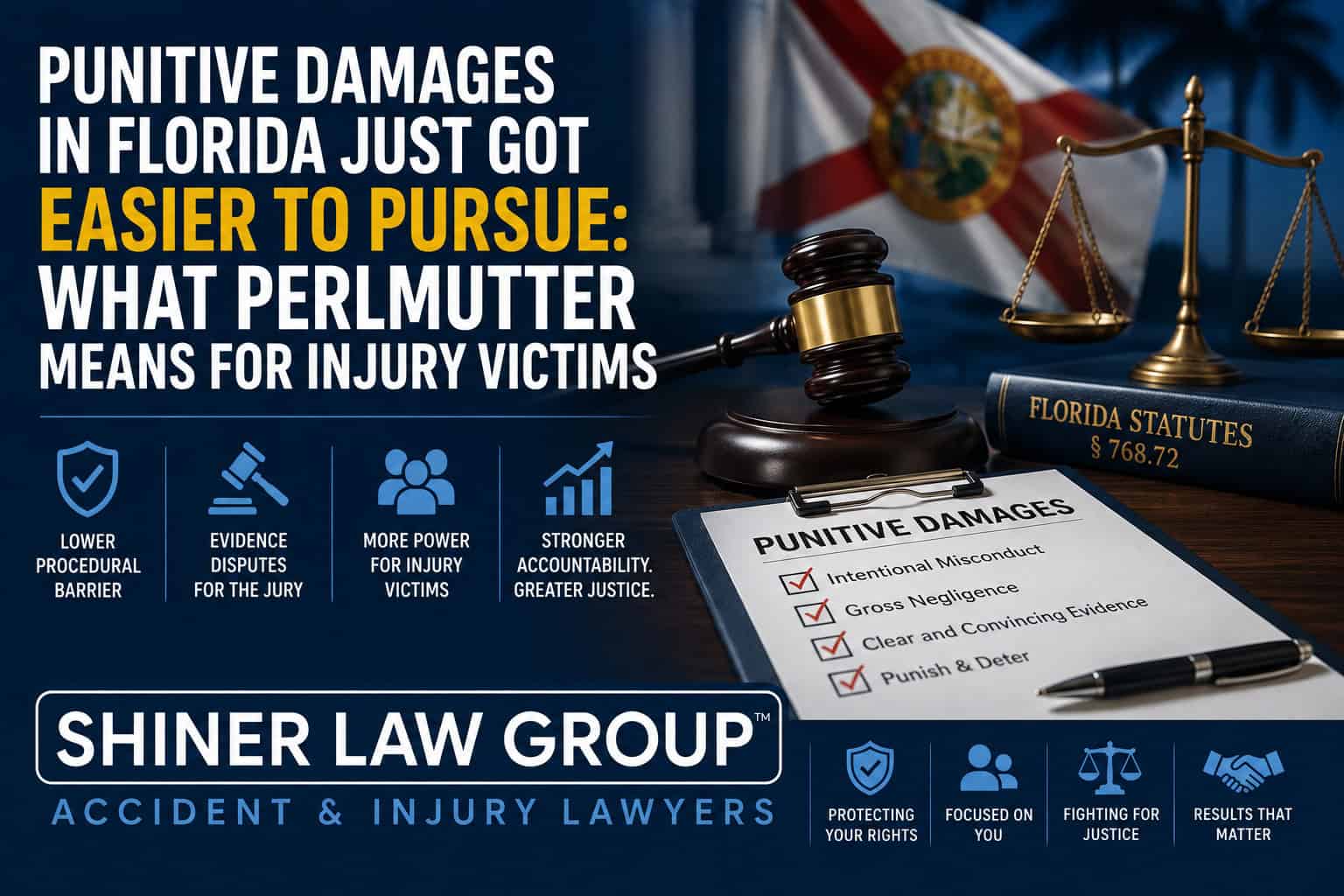
Key Takeaways
- Punitive damages punish a defendant for intentional misconduct or gross negligence - and are awarded on top of your compensation for medical bills, lost wages, and pain and suffering.
- In June 2026, the Florida Supreme Court unanimously ruled in Perlmutter v. Federal Insurance Co. that injury victims only need a "reasonable evidentiary showing" to add punitive damages to a lawsuit.
- Judges may no longer weigh the defense's competing evidence or demand trial-level proof at the pleading stage - those disputes now belong to the jury.
- Drunk driving, commercial trucking, negligent security, and nursing home abuse cases are among those most likely to benefit.
- Once punitive damages are pled, Florida law generally opens discovery into the defendant's financial worth - which often changes settlement dynamics.
If you were seriously injured by a drunk driver, a trucking company that ignored safety rules, or a business that knew about a danger and did nothing, you may have heard the term punitive damages - and wondered whether they apply to your case. In June 2026, the Florida Supreme Court issued one of the most important punitive damages decisions in decades, and it directly benefits injury victims. Here is what changed, in plain English, and what it could mean for your claim. For the full attorney-level analysis, see our complete case law update on Perlmutter v. Federal Insurance Co. prepared by our legal team.
What Are Punitive Damages in Florida?
Punitive damages are money a jury can award in addition to your compensatory damages. Their purpose is not to reimburse you - it is to punish a defendant for egregious conduct and to deter that defendant and others from acting the same way again.
Under section 768.72, Florida Statutes, punitive damages are reserved for the worst conduct. At trial, an injury victim must ultimately prove by clear and convincing evidence that the defendant engaged in either:
- Intentional misconduct - the defendant knew the conduct was wrong and highly likely to cause injury, and did it anyway; or
- Gross negligence - conduct so reckless it showed a conscious disregard or indifference to the life, safety, or rights of others.
Think of the drunk driver with prior DUIs, the trucking company that let a fatigued driver falsify hours-of-service logs, or the property owner who ignored repeated violent incidents and provided no security. That is punitive damages territory.
What Did the Florida Supreme Court Decide in Perlmutter?
In Perlmutter v. Federal Insurance Co., No. SC2024-0058 (Fla. June 11, 2026), the Florida Supreme Court unanimously held that to add a punitive damages claim to a lawsuit, an injury victim only needs to make a reasonable evidentiary showing - evidence that, if believed, could support punitive damages. The judge may not weigh the defendant's competing evidence, judge witness credibility, or require trial-level "clear and convincing" proof at that early stage.
Why does that matter? Florida has a two-step system. You cannot include punitive damages in your initial lawsuit - you must first ask the court for permission to amend your complaint and show an evidentiary basis for the claim. For years, Florida's appellate courts disagreed about how demanding that step should be. Some courts - most notably the Fourth District Court of Appeal, which covers Palm Beach, Broward, and the Treasure Coast - effectively required injury victims to win a mini-trial before they could even plead punitive damages, weighing the defense's competing affidavits and expert reports against the victim's evidence.
The Florida Supreme Court rejected that approach 7-0. The Court held that section 768.72 makes trial judges gatekeepers, not factfinders. The judge's only job at the pleading stage is to ask: if the injury victim's evidence is believed, could it reasonably support punitive damages? Disputed facts, credibility questions, and competing stories belong to the jury - where they have always belonged.
Punitive Damages Before and After Perlmutter
| Question | Before Perlmutter (in some districts) | After Perlmutter (statewide) |
|---|---|---|
| Standard to plead punitive damages | Some courts demanded evidence measured against the trial-level clear and convincing standard | A reasonable evidentiary showing - evidence that, if believed, could support punitive damages |
| Can the defense fight back with its own evidence? | Yes - courts in some districts weighed competing affidavits, expert reports, and deposition testimony | No - the court considers only the claimant's evidence at this stage; disputes go to the jury |
| Does the judge decide credibility? | Effectively yes, in districts requiring a mini-trial | No - credibility and factual disputes are reserved for the jury |
| Burden of proof at trial | Clear and convincing evidence | Unchanged - still clear and convincing evidence |
| Consistency across Florida | Different rules in different districts | One uniform statewide standard |
Which Injury Cases Are Most Likely to Involve Punitive Damages?
Based on the conduct Florida courts have historically treated as intentional misconduct or gross negligence, the Perlmutter decision will likely matter most in cases involving:
- Drunk and impaired driving - Florida courts have long recognized that driving under the influence can support punitive damages;
- Commercial trucking violations - falsified logs, ignored maintenance, coerced hours-of-service violations, and companies that keep dangerous drivers on the road;
- Negligent security - property owners who knew about repeated crimes and did nothing to protect guests and residents;
- Nursing home abuse and neglect - chronic understaffing and ignored warning signs that lead to preventable harm;
- Defective products - manufacturers that knew about a danger and concealed it;
- Corporate misconduct - reckless policies, ratification of employee wrongdoing, or destruction and concealment of evidence.
Do Punitive Damages Increase What My Case Is Worth?
They can, substantially - in two ways. First, punitive damages are awarded on top of your compensatory damages. Second, once punitive damages are properly pled, Florida law generally allows discovery into the defendant's financial worth - net worth, financial statements, and corporate balance sheets. That visibility often changes how insurers and corporate defendants value settlement.
After Perlmutter, injury victims should reach the punitive damages stage more often and earlier in litigation. Defense lawyers can no longer bury a punitive damages motion under competing affidavits and expert reports; if your evidence, taken as true, reasonably supports the claim, the amendment should be allowed and the jury - not the judge - will decide whom to believe.
What Should I Do If I Think Reckless Conduct Caused My Injury?
Three things matter most:
- Act quickly. Florida's statute of limitations gives most injury victims only two years to file a negligence lawsuit - and the evidence that supports punitive damages (surveillance video, driver logs, corporate records, witness memories) disappears far faster.
- Preserve evidence. An attorney can send preservation letters immediately so trucking companies, businesses, and insurers cannot quietly discard the records that prove gross negligence.
- Do not settle before the full picture is known. Insurers often push quick settlements precisely in the cases where punitive exposure is highest. Once you sign a release, the punitive claim is gone forever.
Shiner Law Group has recovered more than $500 million for injured clients across Florida, with eight offices statewide. If someone's reckless or intentional conduct caused your injury, we will evaluate your case - including potential punitive damages - for free. Learn more about our Florida personal injury practice or start with a free case evaluation.
Injured by Reckless or Intentional Conduct?
Get a free, confidential case review from Shiner Law Group. No fee unless we win. Available 24/7.
Related Reading
Frequently Asked Questions
What are punitive damages in Florida?
How did the Perlmutter decision change punitive damages in Florida?
What types of accident cases can involve punitive damages in Florida?
Do punitive damages increase the value of my injury case?
How long do I have to file a personal injury lawsuit in Florida?
This article is provided by Shiner Law Group for general informational purposes only and is not legal advice; reading it does not create an attorney-client relationship. Every case is different, and the availability of punitive damages depends on the specific facts and evidence in your case. Sources: Perlmutter v. Federal Insurance Co., No. SC2024-0058 (Fla. June 11, 2026); § 768.72, Fla. Stat.; Fla. R. Civ. P. 1.190(f). Attorneys at Shiner Law Group are Members of The Florida Bar. This is attorney advertising.