
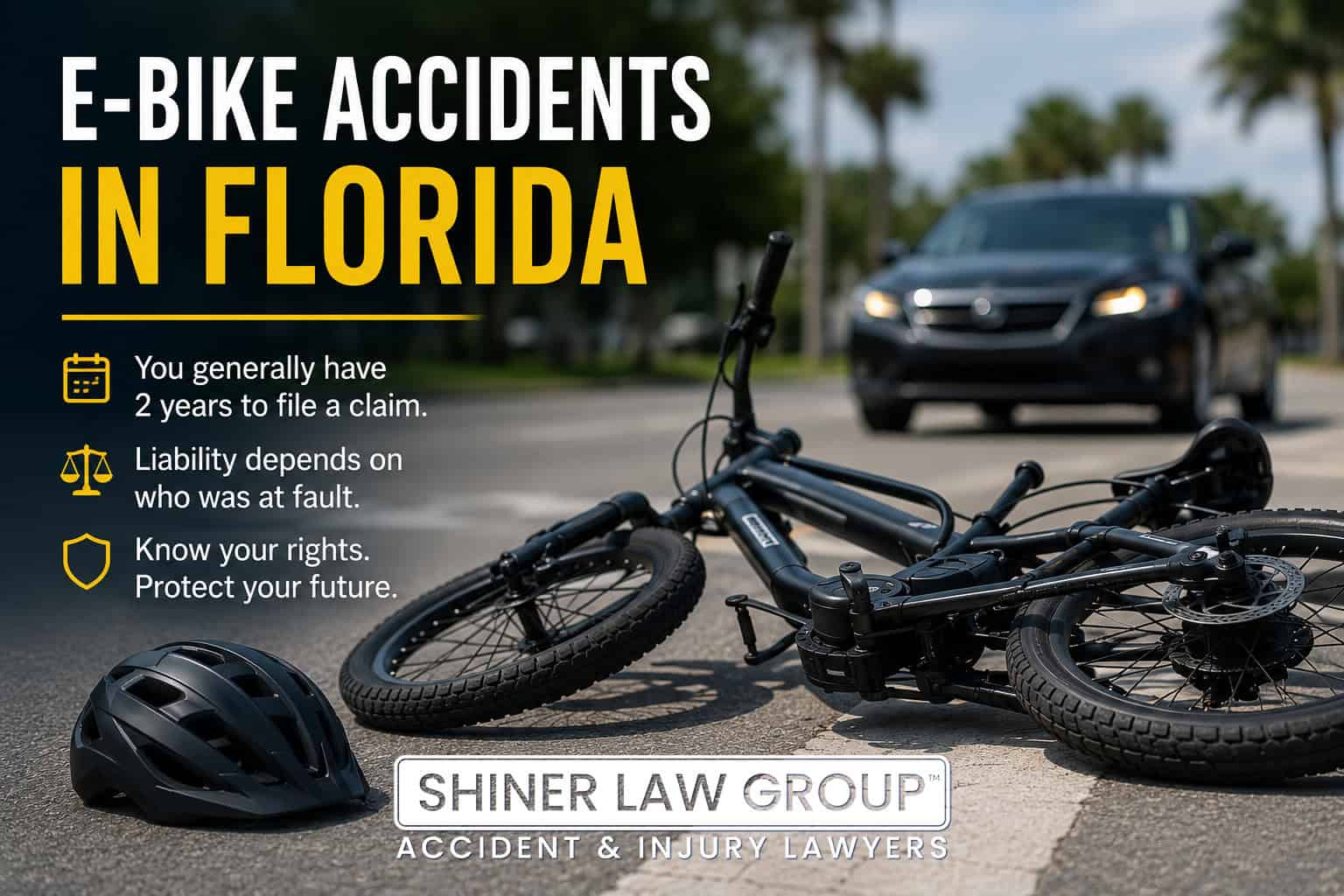
If you were hurt in an e-bike or e-scooter accident in Florida, you generally have two years to file a claim. Liability depends on who was at fault and where the crash happened: an e-bike rider struck by a car can pursue the driver (and may use their own auto PIP), while a pedestrian struck by an e-bike usually pursues the rider directly, because e-bikes rarely carry insurance. Florida treats most e-bikes like bicycles, but a growing number of cities have banned them from sidewalks and trails - and a new statewide law caps speeds near pedestrians.
↓ Get the free Florida E-Bike Safety & Rights Guide- E-bike use - and injuries - are surging. Palm Beach County recorded its highest number of e-bike deaths on record in 2025, even as overall traffic deaths fell.
- Florida treats most e-bikes like bicycles. No license, registration, or insurance is required, but riders cannot use the motor on sidewalks and must yield to pedestrians.
- Cities are cracking down. The Town of Palm Beach, Key Biscayne, Tampa, and others have restricted or banned e-bikes in pedestrian areas, using new power granted by the state.
- A statewide law is coming. SB 382 limits e-bikes to 10 mph near pedestrians and requires an audible signal when passing - with penalties set to begin July 1, 2026.
- Liability is rarely simple. The rider, a motorist, the parent of a minor rider, a property owner, or a manufacturer may be responsible - and finding insurance coverage is often the hardest part.
- The clock is short. You generally have two years to file, and being more than 50% at fault bars recovery under Florida law.
Electric bikes and scooters have exploded in popularity across Florida - and so have the crashes. Whether you were riding when a car hit you, or you were walking when a speeding e-bike struck you, the law in this area is changing fast, and the path to compensation is rarely obvious. Here is what Florida law says, who can be held responsible, and how to protect your rights.
Are E-Bikes Being Banned in Florida?
Not statewide - but city by city, the restrictions are spreading quickly. Florida gave local governments new authority to regulate e-bikes and similar devices, and several communities have already acted:
- In October 2025, the Town of Palm Beach voted unanimously to ban e-bikes, scooters, and other motorized devices from all sidewalks, multimodal trails, and the Lake Trail.
- Key Biscayne imposed an emergency ban after a fatal crash in which a bicyclist was killed in a collision with a child riding an e-bike.
- Tampa prohibits sidewalk riding in designated business districts, and communities from Orange County to South Florida are weighing their own rules.
At the state level, Senate Bill 382 cleared the Florida Legislature unanimously in early 2026, was ordered enrolled on March 17, 2026, and as of this writing awaits the Governor's action. Rather than banning e-bikes, it focuses on pedestrian safety: riders may not exceed 10 mph on a sidewalk or pedestrian area when a pedestrian is within 50 feet, and must yield and give an audible signal before passing on shared paths. It also creates a statewide Micromobility Device Safety Task Force and, for the first time, requires police to track e-bike crashes. Penalties are set to take effect July 1, 2026.
What Florida Law Says About E-Bikes
Florida law defines an electric bicycle as a bicycle with fully operable pedals, a seat, and an electric motor of 750 watts or less, sorted into three classes:
- Class 1 - pedal-assist only, motor cuts off at 20 mph.
- Class 2 - throttle-assisted, motor cuts off at 20 mph.
- Class 3 - pedal-assist only, motor cuts off at 28 mph.
Most e-bikes are treated like ordinary bicycles, so no license, registration, or insurance is required. Riders generally have the same rights and duties as cyclists - including the rule that an e-bike's motor cannot be used on a sidewalk (it may only be pedaled there), and that riders must yield to pedestrians and signal before passing. SB 382 reinforces those duties and adds the 10 mph pedestrian-zone limit described above.
Why E-Bike and Scooter Injuries Are Rising
As ridership climbs, so do serious crashes. Palm Beach County officials reported that e-bike deaths hit a record high in 2025 - a deadly exception in a year when overall vehicle fatalities actually fell - and county leaders are pushing for better crash reporting because the data has been incomplete. Nationally, the U.S. Consumer Product Safety Commission has linked micromobility devices to hundreds of deaths and hundreds of thousands of emergency-room injuries in recent years, with injuries rising sharply each year.
The most common Florida e-bike injury scenarios fall into a few buckets: pedestrians struck by fast-moving e-bikes on sidewalks, riders hit by cars after being pushed onto roads with no bike lane, and crashes involving inexperienced or underage riders.
Who Is Liable in a Florida E-Bike Accident?
Determining fault is often the hardest part of these cases, because more than one party can share the blame and the answer depends heavily on where the crash happened and whether local rules were followed. Potentially responsible parties include:
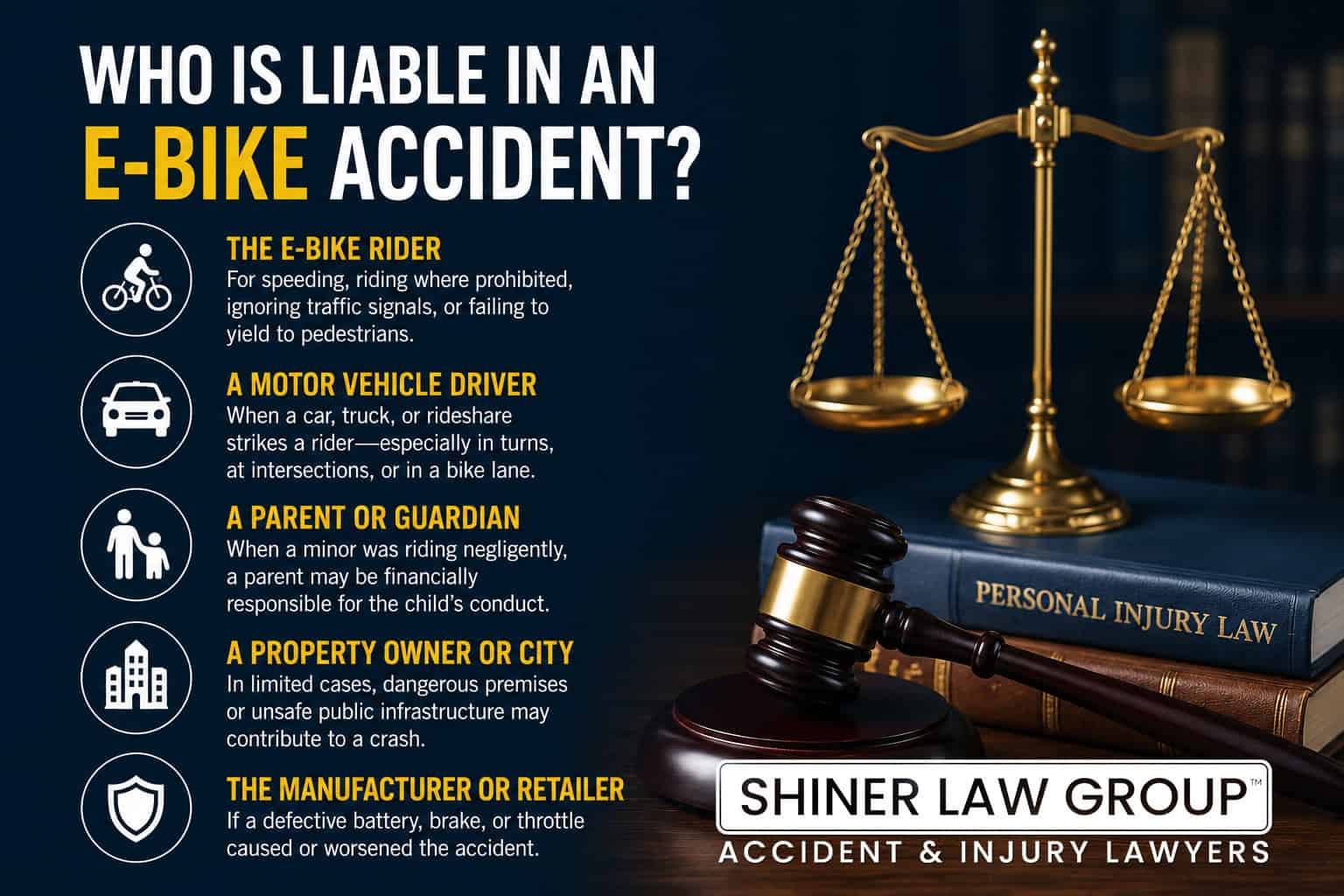
The E-Bike Rider
For speeding, riding where prohibited, ignoring traffic signals, or failing to yield to pedestrians.
A Motor Vehicle Driver
When a car, truck, or rideshare strikes a rider - especially in turns, at intersections, or in a bike lane.
A Parent or Guardian
When a minor was riding negligently, a parent may be financially responsible for the child's conduct.
A Property Owner or City
In limited cases, dangerous premises or unsafe public infrastructure may contribute to a crash.
The Manufacturer or Retailer
If a defective battery, brake, or throttle caused or worsened the crash, a product-liability claim may apply.
An Employer
If the rider was working - for a delivery or gig service - the company may share liability.
Does Insurance Cover an E-Bike Accident in Florida?
This is the question that decides most e-bike cases, and the answer is rarely simple - because e-bikes themselves usually carry no insurance. How you recover depends on who you are in the crash:
If you are an e-bike rider hit by a car: the at-fault driver's liability coverage is your primary target, much like a bicyclist struck by a vehicle. Your own auto PIP (no-fault) coverage may also apply even though you were not in your car, and your uninsured/underinsured motorist coverage can fill gaps if the driver's limits are too low.
If you are a pedestrian struck by an e-bike: there is usually no e-bike insurance to claim against, so recovery may come from the rider's homeowner's or renter's policy, the rider personally, or - depending on the facts - your own coverage. Identifying every available source is exactly where an attorney's investigation matters most.
How Florida's Changing Laws Affect Your Claim
As cities pass sidewalk bans and the state phases in SB 382, the legal landscape is shifting in ways that directly affect injury claims. If a rider operates where a local ordinance prohibits it, or blows past the new 10 mph pedestrian limit, that violation can be strong evidence of negligence.
Florida also follows modified comparative negligence: your compensation is reduced by your share of fault, and if you are found more than 50% at fault, you cannot recover at all. In a shared-space e-bike crash, both sides often point fingers - which is why preserving evidence early is so important.
What to Do After an E-Bike or Scooter Accident
Whether you were riding or on foot, the steps you take in the first hours and days protect both your health and your claim:
- Get medical care right away - even for injuries that seem minor, and within 14 days to preserve PIP. Some injuries surface days later.
- Report the crash to local police so there is an official record of what happened and where.
- Document everything - photos of the scene, the device, vehicle damage and injuries, plus names and numbers of every driver, rider, and witness.
- Identify the device and rider - the e-bike's class, owner, and whether the rider was a minor or working can determine which insurance applies.
- Do not give a recorded statement to any insurer, and do not accept a quick settlement, before speaking with a lawyer.
- Talk to a Florida e-bike accident attorney early, while evidence is fresh and well before the two-year deadline.
How Long Do You Have to File a Claim?
For most Florida e-bike and scooter injury claims, you generally have two years from the date of the accident to file a lawsuit (a deadline shortened from four years in 2023). Miss the statute of limitations and the court will almost certainly dismiss your case, no matter how clear the other party's fault. Because these claims often involve multiple parties and unsettled questions of coverage, it pays to start early.
The Florida E-Bike & Scooter Safety and Rights Guide
E-bike rules are changing faster than most riders, parents, and pedestrians can keep up with. Enter your email and we will send the guide straight to your inbox, plus occasional updates when Florida law changes.
PDF Download - E-Bikes
We respect your privacy and you can unsubscribe at any time. The guide is general information, not legal advice, and requesting it does not create an attorney-client relationship.
Frequently Asked Questions
Injured in an E-Bike or Scooter Accident in Florida?
Whether you were riding or walking, Shiner Law Group can sort out who is responsible and which insurance applies - then fight for the compensation you deserve. The consultation is free, and there is no fee unless we win.