
Can What You Told the Police After a Car Accident Be Used Against You in Florida?
Key Takeaways
- Florida’s accident report privilege (§ 316.066(4), Florida Statutes) means what you tell police for the crash report cannot be used as evidence in any trial — civil or criminal.
- The law exists so drivers can be honest with police without fear their words will be used against them later.
- The privilege has limits: the officer’s own observations, test results, and bystander witness statements are all still admissible.
- The crash report itself is inadmissible at trial — but insurance companies still read it and use it in negotiations.
- Statements to insurance adjusters are not protected — which is why you should talk to an attorney before giving any recorded statement.
What Is Florida’s Accident Report Privilege?
After a crash, a police officer will ask you what happened. Many people are afraid to answer honestly — worried that an offhand remark like “I only looked down for a second” will sink their case or be used to prosecute them.
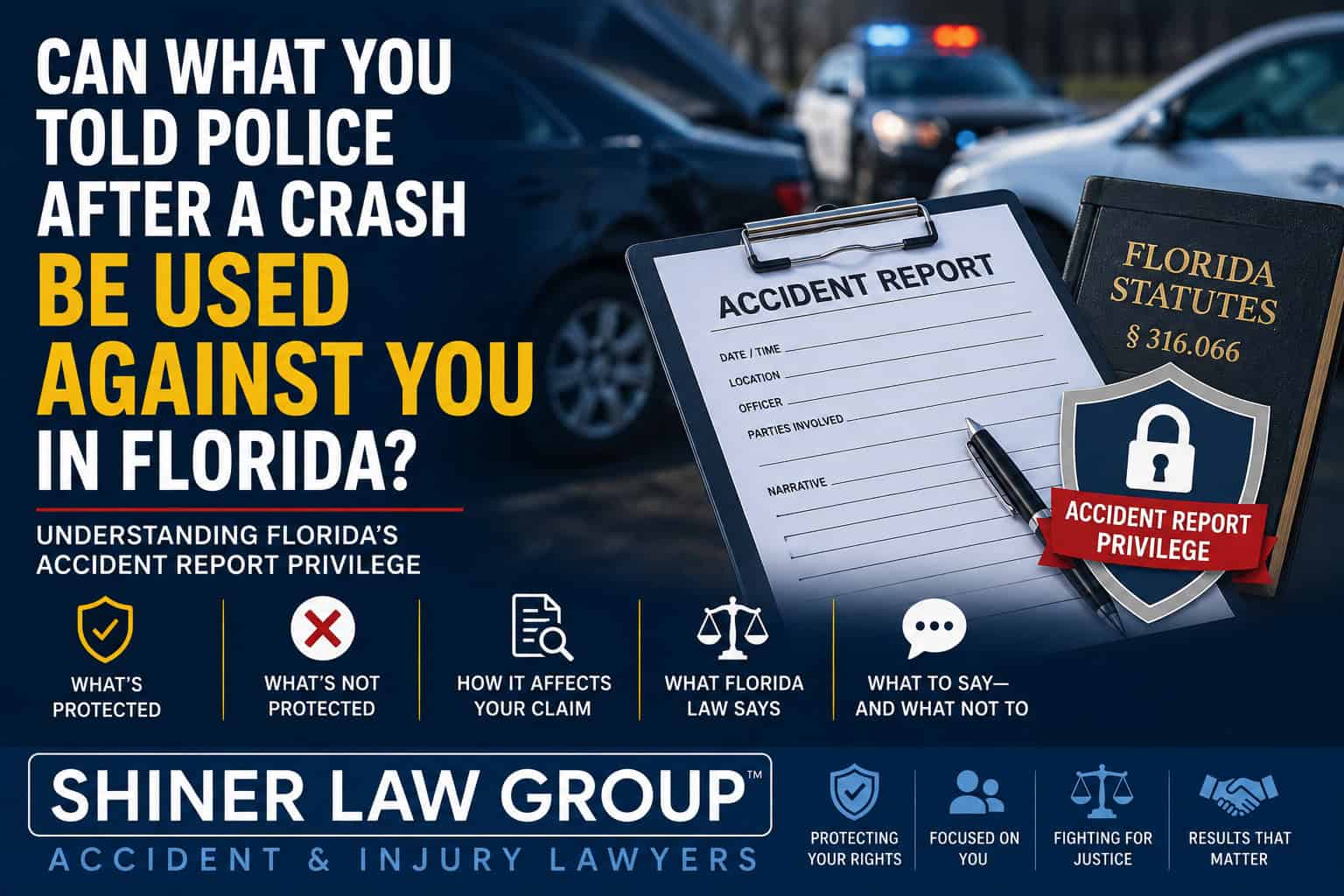
Florida law addresses that fear directly. Under section 316.066(4), Florida Statutes, every crash report made by a person involved in a crash — and every statement that person makes to a law enforcement officer for the purpose of completing the crash report — is made “without prejudice” to that person, and “may not be used as evidence in any trial, civil or criminal.”
The purpose is simple: the state wants accurate crash reporting to make the roads safer, and it wants drivers to cooperate honestly with police without their compelled statements being turned against them. So be truthful with the investigating officer — the law is built to let you.
What’s Protected — and What Isn’t
| Protected (inadmissible at trial) | Not protected (admissible) |
|---|---|
| Your statements to the officer for the crash report (“I was looking down at my radio before the impact”) | The officer’s own observations — vehicle positions, skid marks, measurements, debris |
| The other driver’s statements to the officer for the crash report | Blood alcohol, breath, urine, and field sobriety test results |
| The crash report itself | Statements by bystander witnesses who were not involved in the crash |
| Spontaneous statements and excited utterances not made to complete the report | |
| Statements made after an officer announces a criminal investigation and provides Miranda warnings |
Does the Police Report Itself Come Into Evidence?
No. The crash report is inadmissible at trial. But there are two important wrinkles.
First, Florida courts have clarified that the statute is a rule of inadmissibility at trial rather than a blanket privilege — so the content of protected statements is generally still discoverable during a lawsuit, even though it cannot be shown to the jury.
Second — and this is the part that matters most in the real world — insurance companies read crash reports and lean on them heavily when evaluating and negotiating claims, long before any trial. An unfavorable narrative or diagram in the report can shape an adjuster’s position even though the report could never be admitted in court. An experienced attorney knows how to push back with the evidence that is admissible: witness testimony, photographs, physical evidence, and expert reconstruction.
The Trap Most People Miss: Insurance Adjusters
Here is the critical distinction. The accident report privilege covers what you tell police for the crash report. It does not cover what you tell an insurance adjuster. When the other driver’s insurer calls days after the crash asking for “a quick recorded statement,” nothing about that conversation is privileged — it is being recorded precisely so it can be used to minimize or deny your claim.
What Should I Do After a Crash?
- Cooperate honestly with the investigating officer. The privilege exists so you can — and inaccurate statements help no one, least of all you.
- Don’t speculate or guess. Being honest includes saying “I’m not sure.” Stick to what you actually know.
- Get medical care promptly, and follow through with treatment.
- Document the scene yourself — photos, the other driver’s information, and contact details for witnesses.
- Decline recorded statements to the other driver’s insurer until you have spoken with an attorney — those statements have none of the protections your statements to police have.
Injured in a Crash and Worried About What Comes Next?
Talk to us before you talk to the insurance company. Free, confidential case reviews from Shiner Law Group. No fee unless we win. Available 24/7.
Related Reading
Frequently Asked Questions
Is the police crash report admissible in court in Florida?
Can the insurance company see the crash report?
Are witness statements protected by the accident report privilege?
What if I admitted fault at the scene?
Should I give the other driver's insurance company a recorded statement?
This article is provided for informational purposes only and does not constitute legal advice, nor does it create an attorney-client relationship. Every case is unique, and past results do not guarantee future outcomes. The law discussed here may change, and its application depends on the specific facts of your situation. Attorneys at Shiner Law Group are Members of The Florida Bar. Shiner Law Group — Accident & Injury Lawyers. This is attorney advertising.