
Can You Sue Uber or Lyft After an Assault or Injury in Florida? What the New Haddad Decision Means for Passengers
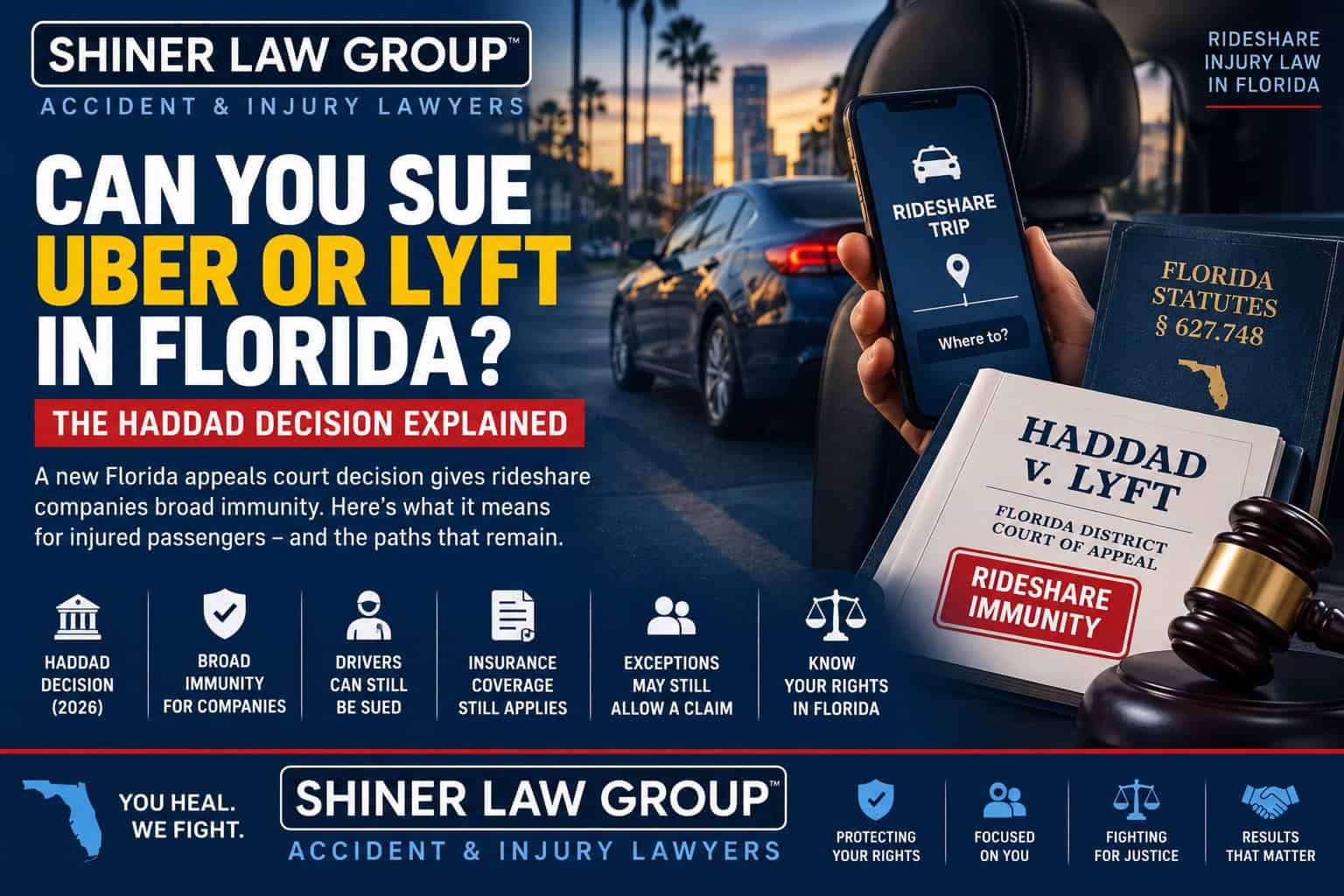
Key Takeaways
- In May 2026, a Florida appeals court held that the state’s rideshare law gives companies like Uber and Lyft broad immunity from most injury lawsuits — even claims about the company’s own safety promises.
- The immunity has exceptions: it does not protect a company that violated the rideshare statute’s own requirements or engaged in criminal wrongdoing.
- The decision does not protect the driver — the person who hurt you can still be sued individually.
- Florida’s rideshare law separately requires substantial insurance coverage for rides, which remains a critical source of compensation.
- Because these cases are now often won or lost at the very first court filing, early legal review matters more than ever.
What Happened in Haddad v. Lyft?
A Lyft passenger alleged she was assaulted by her driver during a ride in 2022. She sued the driver for negligence — and she also sued Lyft itself, arguing that the company’s website promised “high safety standards,” background checks, annual re-screening, criminal monitoring, and safety training, that she relied on those promises when she chose the platform, and that the promises were false or misleading.
On May 13, 2026, Florida’s Fourth District Court of Appeal affirmed the dismissal of her claims against Lyft — with prejudice, meaning they cannot be refiled. The court held that Florida’s rideshare immunity statute, section 627.748(18), is extraordinarily broad: it covers not just claims that try to hold the company responsible for its driver’s acts, but also claims about the company’s own alleged negligence and misrepresentations, so long as the injury arose out of a ride.
What Is Florida’s Rideshare Immunity Law?
Florida’s transportation network company (TNC) statute governs rideshare companies operating in the state. Its immunity provision says a rideshare company is not a common carrier, not a for-hire vehicle service, and not the employer of its drivers — and that the company generally is not liable for injuries “resulting from the use, operation, or possession of a motor vehicle” driven by a rideshare driver who is logged into the app, unless one of two exceptions applies:
- the company was negligent in complying with the rideshare statute itself — for example, its specific requirements governing driver background checks and qualifications; or
- the company engaged in criminal wrongdoing.
The Haddad court read that immunity broadly, observing that the statute “appears to sweep in practically any claim” against a rideshare company arising from injuries during a ride — no matter how the claim is labeled.
What’s Barred — and What Remains
| Likely barred against the company | Paths that remain |
|---|---|
| General negligence claims against the rideshare company | Claims against the driver individually for negligence or intentional acts |
| Negligent hiring, retention, and supervision claims | Claims that the company violated the rideshare statute’s own requirements (background checks, driver qualification, insurance obligations) |
| Claims based on the company’s safety marketing and representations | Claims involving criminal wrongdoing by the company |
| Claims “arising out of” the ride, however they are labeled | The insurance coverage Florida’s rideshare law requires for rides — including coverage of up to $1 million while a passenger is in the vehicle |
Does This Mean Rideshare Victims Have No Case?
No — but it changes how these cases must be built, and it raises the stakes of the very first document filed in court.
First, the driver who caused your injury can still be held personally responsible. Second, Florida’s rideshare law requires insurance coverage for rides, which exists precisely to compensate injured passengers and others on the road. Third, the immunity statute’s exceptions are real: if the company failed to perform the background checks or meet the driver-qualification and insurance requirements the statute imposes, a claim against the company may survive — but only if the lawsuit specifically alleges those statutory violations from the start.
That last point is what makes Haddad so important procedurally. The court confirmed that immunity can be decided on a motion to dismiss — before any discovery into the company’s practices. A complaint that recites general negligence language will likely be dismissed before the victim’s lawyer ever sees a single company record. An experienced attorney now has to investigate potential statutory violations before filing, not after.
What Should I Do After Being Injured or Assaulted During a Rideshare Trip?
- Get to safety and call 911 if you are in danger or injured. A police report creates a contemporaneous official record.
- Get medical care promptly, even if injuries seem minor.
- Preserve the ride details. Screenshot the trip in the app — driver name and photo, route, timestamps — and report the incident through the app so it is documented with the company.
- Preserve the company’s safety representations you saw and relied on, if any.
- Do not give recorded statements to any insurer before speaking with an attorney.
- Get legal advice early. After Haddad, the viability of a claim against the company may be decided entirely by what the first filing alleges.
Injured During a Rideshare Trip?
After Haddad, how your claim is built from day one can decide whether it survives. Get a free, confidential case review from Shiner Law Group. No fee unless we win. Available 24/7.
Related Reading
Frequently Asked Questions
Can I still sue the Uber or Lyft driver who hurt me?
Does rideshare insurance still cover my injuries after Haddad?
What are the exceptions to Florida's rideshare immunity?
Does the Haddad decision apply to Uber too?
How long do I have to file a rideshare injury claim in Florida?
This article is provided for informational purposes only and does not constitute legal advice, nor does it create an attorney-client relationship. Every case is unique, and past results do not guarantee future outcomes. The law discussed here may change, and its application depends on the specific facts of your situation. Attorneys at Shiner Law Group are Members of The Florida Bar. Shiner Law Group — Accident & Injury Lawyers. This is attorney advertising.